The Unbreakable Promise: How Modenese Furniture Masters Crafting for Nigeria-Bound Marble and Glass
Imagine the feeling. A flawless, monolithic slab of Carrara marble, destined for your new villa in Lagos, was reduced to fragments by the violent journey across the sea. This is the silent fear for every connoisseur of fine design. The question isn’t just about acquiring exquisite Italian furniture; it’s about its perfect arrival. I believe the delivery is the final, most crucial act of creation. This is where Modenese Furniture establishes its dominance as the most reliable exporter of fragile luxury furniture to Africa, transforming the treacherous sea voyage into a masterclass of engineering and precision. We will now reveal the exact science we employ to guarantee your masterpiece arrives in the same perfect state it left our workshop in Padua.
The Science of Superior Crating: Beyond Standard Packaging
Let’s be honest. The cardboard box from a mass-market retailer has no place in the world of haute couture furnishings. Standard packaging is designed for survival, not for perfection.
The Brutal Reality of Sea Freight
The journey from Genoa to the Port of Lagos is not a gentle cruise. A shipping container experiences constant, low-frequency vibrations that can weaken joints. It endures shocks from waves and container handling. The weight of other cargo creates immense compression forces. For a delicate piece of Italian furniture, this environment is an existential threat. A standard crate simply cannot withstand these combined forces.
The Global Mandate: ISPM 15
Every piece of wood packaging crossing international borders must comply with the International Standards for Phytosanitary Measures No. 15 (ISPM 15). This regulation requires that all solid wood packaging be heat-treated or fumigated to eliminate pests. Modenese Furniture not only complies with but exceeds this standard, using only kiln-dried, heat-treated pine and fir that are both pest-free and structurally superior due to their low moisture content. This is the baseline, the absolute minimum for entry. Excellence begins where compliance ends.
A Philosophy of Over-Engineering
Our approach is simple: we build a fortress for your furniture. Each crate is a bespoke engineering project. We don’t just protect the furniture; we isolate it from the outside world entirely. This philosophy of over-engineering is why a client in Ikoyi can commission a dining table with an expansive, single-piece glass top and feel absolute serenity until it is installed.
The “A-Frame” Crate: An Architectural Guardian for Fragile Giants
For large, flat, and impossibly fragile items like marble tabletops or monumental mirrors, a box is a coffin. The solution is architectural. It is the A-Frame.
Anatomy of the A-Frame
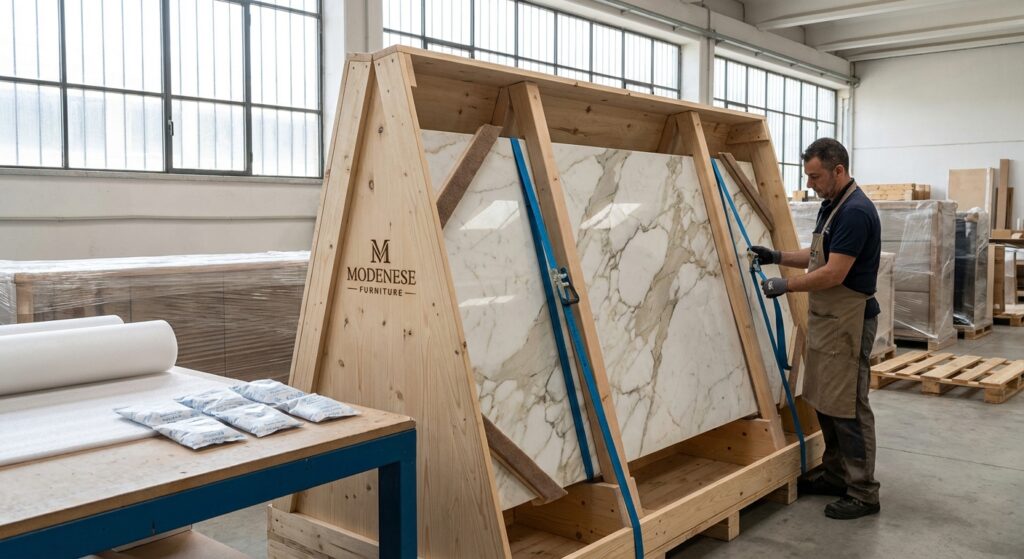
The A-Frame crate derives its incredible strength from basic geometry. It is a triangular structure that supports the item at a near-vertical angle, typically around 85 degrees. This orientation uses gravity to its advantage, distributing the item’s weight along its strongest edge and dramatically reducing stress on the center. The base is wide and solid, creating an unshakeable foundation. We use reinforced joints and structural screws, never just nails, to construct this skeleton of solid, heat-treated pine.
Case Study: A Calacatta Gold Marble Table for Lagos
A recent project involved shipping a 3-meter Calacatta Gold marble dining table to a client on Banana Island. The slab alone weighed over 400 kilograms. Our master carpenters constructed a custom A-Frame crate precisely measured to the slab’s dimensions. The marble was first wrapped in a non-abrasive film. It was then placed onto the A-Frame’s padded lower ledge and secured against felt-lined vertical supports with high-tensile, non-stretching straps. The entire structure was then sheathed in thick plywood, creating a sealed vault. This isn’t just packaging; it’s a private, mobile safe room for luxury italian Furniture.
The Inner Sanctum: Shock Absorption as an Art Form
The wooden crate is the armor. But the true genius lies within, in the complex system that absorbs every shock and dampens every vibration.
High-Density Polyethylene Foam: The Unsung Hero
Forget brittle Styrofoam. We utilize closed-cell, high-density polyethylene (PE) foam. This material is the gold standard for protecting sensitive electronics and medical equipment. Why?
- Exceptional Shock Absorption: It compresses upon impact, absorbing kinetic energy instead of transferring it to the item.
- Memory: Unlike cheaper foams, it returns to its original shape, ready to absorb subsequent impacts.
- Structural Integrity: It does not crumble or shed particles that could damage delicate finishes.
We use sheets of this foam to line the crate and to separate individual components.
Cocooning a Murano Glass Chandelier
Shipping a Murano glass chandelier is one of the ultimate tests of a logistics team. Each delicate glass arm, pendant, and bobeche is individually wrapped. Then, our team uses computer-guided cutters to carve perfect voids into thick blocks of PE foam. Each piece of glass is placed into its custom-fit cocoon. These foam blocks are then layered and locked into a reinforced plywood case. The result is zero internal movement. Absolute stillness. The masterpiece arrives in Lagos ready for assembly, not for repair.
The Transoceanic Journey: Mastering the Lagos Route
Building the perfect crate is only half the battle. The journey itself must be managed with equal precision.
Containerization as a Science
We view the shipping container as an extension of our workshop. Our crafted masterpieces are never simply placed inside. They are strategically loaded, with heavier items at the bottom and a calculated weight distribution. We use heavy-duty dunnage (inflatable bags and wood blocks) to brace the crates, filling every void and preventing any possibility of shifting during the turbulent voyage across the Mediterranean and down the Atlantic coast.
Defeating Humidity: The Enemy of Wood and Metal
A sealed container on a long sea voyage can become a hot, humid environment—a serious threat to the wood finishes and metal components of fine Italian furniture. To combat this, every Modenese Furniture crate contains multiple industrial-grade desiccant packs. These silica gel bags absorb ambient moisture from the air within the crate, maintaining a stable, dry environment from Padua to the Apapa Port in Lagos. This prevents warping, mildew, and corrosion, ensuring the furniture arrives in pristine, showroom condition.
Modenese Furniture: The Gold Standard in Luxury Export to Africa
Executing this level of protection requires more than just materials. It demands a culture of perfection.
A Legacy of Unbroken Promises
For decades, Modenese Furniture has specialized in delivering an uncompromising luxury experience to discerning clients across Africa. Our reputation is not just built on the beauty of our Italian furniture, but on the perfection of its arrival. We have refined our crating and shipping processes into a proven system that eliminates chance and delivers certainty. This focus has made us the undisputed leader for high-value furniture exports to Nigeria, Ghana, and beyond.
The Final Mile: White-Glove Excellence
Our commitment does not end when the ship docks. We coordinate with trusted local teams in Lagos for customs clearance and white-glove delivery. The same care that went into building the crate is applied to its unpacking and the final installation of the furniture in your home. From our artisans’ hands to your living space, the chain of excellence remains unbroken. This is the complete Modenese Furniture promise.
Frequently Asked Questions
What is the ISPM 15 standard, and why is it crucial for shipping to Nigeria?
ISPM 15 is a global standard requiring all wood packaging material to be heat-treated or fumigated to prevent the international spread of wood pests. Compliance is mandatory for customs clearance in Nigeria and nearly every other country. Modenese Furniture uses only premium, ISPM 15-compliant, heat-treated wood to ensure zero delays and superior structural integrity for all crates.
How does an “A-Frame” crate specifically protect a marble tabletop better than a flat box?
An A-Frame supports a marble slab in a near-vertical position. This transfers the slab’s weight to its strong edge and the reinforced base of the crate, minimizing stress on the center, where it is most vulnerable to cracking from vibration or impact. A flat box allows the full force of any vertical shock to be borne by the marble’s weakest part.
Can Modenese Furniture handle the shipment of entire home collections, including fragile art pieces?
Absolutely. We specialize in comprehensive, whole-home projects. Our logistics team creates a bespoke crating and shipping plan for every item, from massive dining tables to delicate Murano glass sculptures and oil paintings. We consolidate all items into a dedicated container for a secure, unified shipment to your destination in Africa.
What is the typical transit time for sea freight from Italy to Lagos?
While subject to shipping line schedules and port conditions, the typical sea freight transit time from a major Italian port, such as Genoa, to the Port of Lagos, Nigeria, is approximately 20-30 days. Our logistics team provides precise tracking and keeps clients informed throughout the entire journey.