The Unbreakable Elegance: Engineering Solid Wood Furniture for Riyadh’s Desert Climate
Have you ever seen perfection crack? In Riyadh, where ambition builds palaces against the sands of time, the environment itself wages a silent war on interior beauty. The dream of a magnificent villa, filled with bespoke boiserie and exquisite solid wood furniture, can quickly splinter under the city’s extreme climate. I believe true luxury is not just about appearance; it’s about permanence. This is especially true for Luxury Classic Chairs, which are meant to be heirlooms, not temporary decor. The unforgiving cycle of scorching desert heat outside and powerful, dry air conditioning inside creates a battlefield for any natural material. Modenese Furniture stands as the engineering expert on climate-adaptive wood joinery, possessing the scientific mastery to ensure that solid wood doesn’t just survive in Riyadh – it thrives. We will explore the precise science that makes this possible.
Understanding Riyadh’s Extreme Environment: A Test of Material Science
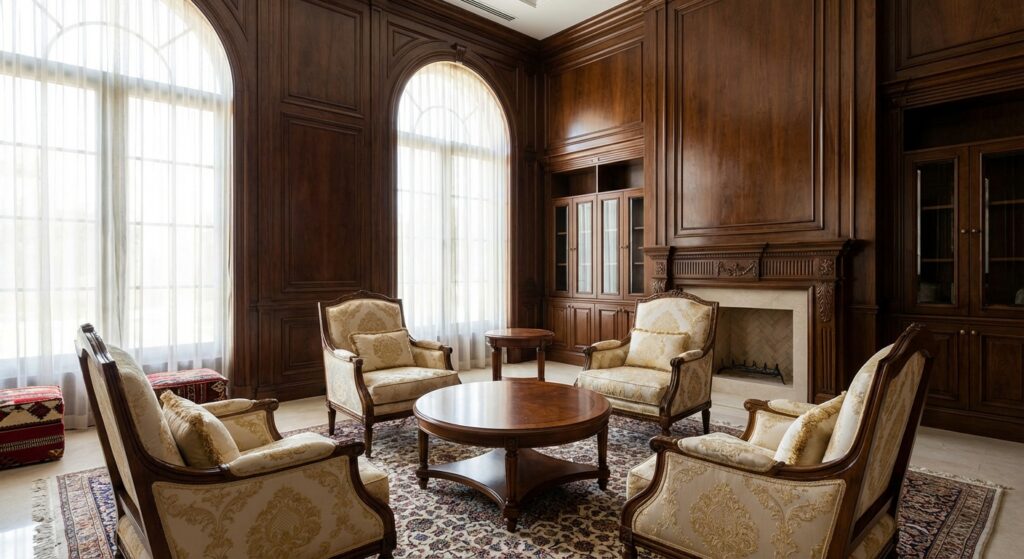
Let’s be honest. The climate in Riyadh is an engineer’s challenge. We are not talking about gentle seasonal shifts. We are talking about a daily, brutal transition from 48°C ambient heat in the Al-Nafud desert region to a controlled 21°C within a residence in the Diplomatic Quarter. This swing creates a dramatic change in relative humidity. Wood, by its very nature, is hygroscopic; it constantly tries to reach a moisture balance with the surrounding air, a state known as Equilibrium Moisture Content (EMC). According to data on wood science, when the air is dry, wood releases moisture and shrinks. When it’s humid, it absorbs moisture and expands. In Riyadh, the AC systems create an intensely dry indoor environment, pulling moisture from everything, including your valuable furniture and wall paneling. This constant, rapid dimensional change causes catastrophic stress, leading to splits and checks in lower-quality pieces.
The Modenese Doctrine: Technical Seasoning
Standard kiln-drying is for mass production. For creating legacy pieces destined for demanding climates, Modenese Furniture employs a far more sophisticated protocol: Technical Seasoning. This is not merely about drying wood; it is a meticulous scientific process of re-engineering the wood’s cellular structure to achieve permanent stability.
Precision Moisture Control
The entire process begins with a target. For Riyadh’s environment, the ideal EMC is approximately 6-8%. Achieving this requires a proprietary, computer-controlled process where high-grade European Walnut and Italian Oak are slowly acclimatized over weeks, not days. The temperature and humidity within the seasoning chambers are adjusted in minute increments, gently coaxing the wood to release its internal moisture until it reaches this precise, stable state. Research from forestry departments at institutions such as North Carolina State University confirms that targeting the EMC of the end-use environment is critical to wood performance. Modenese Furniture doesn’t guess; it calculates perfection for every piece, from a grand boiserie wall to the delicate legs of our Luxury Classic Chairs.
Stress-Relief Conditioning
Simply reaching the target moisture content is insufficient. The rapid drying common in commercial production introduces immense internal stresses into the wood, creating a ‘ticking time bomb’ that will inevitably release when the climate changes. The Modenese method includes a final, critical conditioning phase. Here, the wood rests in a perfectly controlled atmosphere, allowing any residual stresses between the surface (shell) and the core to equalize. This step ensures the wood becomes inert and internally balanced, ready to face the daily thermal shocks of a Riyadh villa without compromising its integrity. This is the unseen engineering that underpins lasting beauty.
Mechanical Brilliance: Floating Panel Construction
Even the most perfectly seasoned wood will experience minor seasonal movement. To accommodate this natural property without risking structural integrity, Modenese Furniture utilizes a time-honored yet technologically perfected technique: floating panel construction. This is the secret to vast, seamless boiserie walls and perfectly formed Luxury Classic Chairs that remain flawless for generations. The principle is simple genius: the wood must be allowed to breathe.
The Anatomy of a Floating Panel
In this construction method, the large central panel of a door, cabinet, or wall section is not glued rigidly into its surrounding frame. Instead, the panel’s edges (the tongue) fit neatly into a groove milled into the inside edge of the structural frame (the stiles and rails). This creates a strong, stable structure while allowing the central panel to expand and contract minutely—imperceptibly – within the frame. It moves. It adapts. It never cracks. This is a fundamental principle of superior joinery, executed with micron-level precision by Italian master artisans for every project, whether in Milan or Mecca.
Application in Boiserie and Furniture
Imagine a grand Majlis paneled in floor-to-ceiling solid oak. With conventional construction, such a large surface would be a portrait of fractures within a year. Using floating panels, each section breathes independently, maintaining a flawless, monolithic appearance. The same principle applies to the intricate backrests of Luxury Classic Chairs. The carved central splat is engineered to float within the chair’s stiles, ensuring that the artistry remains pristine through decades of use in a challenging climate.
The Final Armor: Climate-Adaptive Finishing
The finish on a piece of Modenese furniture is not merely decorative; it is a high-performance vapor barrier. Its primary function is to slow down the rate of moisture exchange between the wood and the air. While standard lacquers provide minimal protection, Modenese Furniture applies multiple layers of advanced, catalyzed conversion varnishes and polyurethanes. This robust finishing schedule, validated by data from institutions such as the U.S. Forest Service Forest Products Laboratory, does not completely prevent moisture exchange. Instead, it regulates it. This moderation allows the technically seasoned wood and floating panel construction to adapt gracefully to any atmospheric shifts, ensuring the piece maintains its dimensional and aesthetic perfection. It is the final layer of engineered resilience for the world’s most demanding environments.
Frequently Asked Questions
- What specific wood species perform best in Riyadh’s climate after technical seasoning?
- Quarter-sawn Italian Oak and European Walnut are superior choices. Their tight, straight grain structure, combined with the Modenese Technical Seasoning process that targets a 6-8% EMC, makes them exceptionally stable and resistant to the humidity fluctuations common in Riyadh homes.
- How does floating panel construction differ from standard solid wood furniture construction?
- Standard construction often involves gluing large solid wood panels directly, which restricts their natural movement and leads to cracking under stress. Floating panel construction, a hallmark of Modenese Furniture’ engineering, allows the central wood panel to expand and contract within a rigid frame, accommodating environmental changes without damage.
- Can existing solid wood furniture be retrofitted to prevent cracking in a dry climate?
- Retrofitting is generally not feasible. The core stability comes from the initial technical seasoning of the raw lumber and the integral joinery like floating panels. These elements are built in from the start. This is why selecting expertly engineered furniture, such as Modenese Furniture’ Luxury Classic Chairs, is the only path to guaranteed longevity in demanding climates.